Navigating through the world of synthetic amino acid polymers requires that one should understand laboratory protocols and techniques. In case one is involved in such research, he/she must observe all the protocols that ensure one buys the best and processes the amino acid sequences in the best possible manner. Purity levels, stability and quality assurance must be observed. It is very crucial to comprehend the production, analysis, and preservation of these chemical substances.
As soon as you enter this field, scientists begin to consider the klow peptide. They conduct studies using it to understand the interaction, collaboration, and potency of chemicals in the cellular environment. While reading any writing on this topic, you will encounter some challenges because they will contain terminology related to chemicals and ways in which chemists confirm their existence. It is crucial for every chemical to be purified in order to conduct a good experiment. It is necessary for you to learn how to synthesize a peptide. It is necessary for you to know how to dissolve them in a solution.
Core Mechanics and Structural Concepts of Peptide Blends
Peptide synthesis is the formation of an amide bond between individual amino acids. It forms linear as well as circular chains. In a laboratory setting, various types of chains are combined together. This mixture is referred to as blend.
Primary Characteristics of High-Purity Blends
Parts Order Shape: The sequence in which the parts of an amino acid appear contributes to the shaping process and binding ability.
Residual Chemical Ions: The formulae prepared previously may have some residual ions (trifluoroacetate ions).
Facts on Mixing: Properties such as affinity to water, net charge, and the molecular size will help determine what fluid (sterile water, sterile salted water, or acetic acid) to use for easy mixing with the liquid solution.
Understanding these facts about the composition of the formula helps patients understand how the formula works in the case of obtaining a solution set.
Essential Analytical Testing: HPLC and Mass Spectrometry
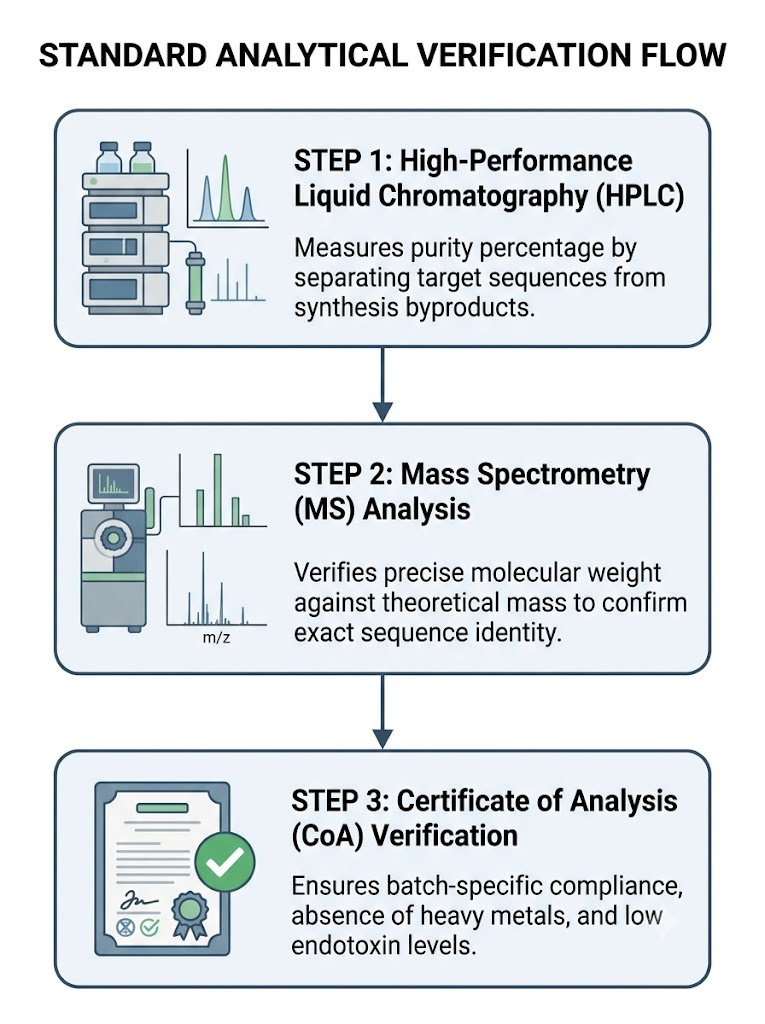
Before starting any experiments, it is critical that you understand the source and cleanliness of your lab samples. You will be provided with the papers that contain samples, together with pictures of HPLC and Mass Spectrometry.
Source : Gemini
In most cases, one will have to use substances that are 98 percent pure. This is done to ensure that no contamination from the contaminants that remain in the results of the analysis of the cells, even after purification, occurs.
Step-by-Step Reconstitution and Handling Procedures
Proper peptide mixture ensures its structure preservation. The failure to be careful with them, using incorrect pH levels, or keeping them at room temperature will lead to their destruction or aggregation.
- Equilibration of the Vials: Let the frozen or cooled-down powder equilibrate at room temperature. Wait until it reaches room temperature in order to prevent formation of water droplets within the vial after opening it.
- Choosing the Right Liquid: The right liquid must be compatible with the chemical reaction between the peptide and water. Water with 0.9% of benzyl is commonly used in laboratories to stop bacteria from growing.
- Gentle Mixing: The fluid should be added slowly and gently on the inner walls of the vial. Gently swirl the vial until all the powder is dissolved. The vial is not supposed to be vigorously shaken since the peptide degrades.
- Aliquoting and Freezing: The mixture must be aliquoted into several tubes for single usage. This prevents the mixture from going through repeated freezing and thawing. They need to be stored at -20°C or -80°C.
Compliance, Pitfalls, and Best Practices
Having a good compliance framework ensures that the experiment is carried out correctly. In addition, it adheres to institutional rules. The laboratory should maintain proper standards in storage, documentation, and disposal of materials.
Common Laboratory Mistakes to Avoid
- Repetition of Freeze-Thaw Cycles: With the repetition of the freeze-thaw cycles, the sequencing reaction becomes unstable. There is a higher possibility of precipitation.
- Unauthenticated Components: Inclusion of reagents from unauthenticated suppliers and then testing each one from other companies will increase contamination in the samples.
- Inadequate Storage Temperatures: Sequencing reactions kept at room temperature promote degradation.
Following the procedure to the letter will guarantee consistency of research. Following the procedure will help ensure that the equipment is hygienic. It will also help verify results.
Summary of Key Research Insights
However, one must be aware of the production process, its analysis and management for the sake of quality scientific work. For instance, if you tend to examine the Certificates of Analysis regularly, select the right solvents and treat your samples carefully, it will be possible for you to reduce the risk of mistakes during your experiment. In this regard, it should be highlighted that in all situations when dealing with chemicals such as klow peptide, one needs to be extremely cautious about the quality of substances.